|
World Braille
Day |
4 January |
|
World Leprosy
Day |
Last Sunday
in January |
|
World
Cancer Day |
4 February |
|
International
Day of Zero Tolerance for Female Genital Mutilation |
6 February |
|
National Deworming Day |
10 February |
|
International
Epilepsy Day |
second Monday
of February |
|
International
Day of Women and Girls in Science |
11 February |
|
World Unani Day |
11 February |
|
Sexual Reproductive Health
Awareness Day |
12 February |
|
International
Childhood Cancer Day |
15
February |
|
World Day of
Social Justice |
20 February |
|
Rare Disease
Day |
28/29
February |
|
International
Condom Day |
13 February |
|
Zero Discrimination Day |
01Mar |
|
World Birth Defect Day |
03Mar |
|
World Hearing Day |
03Mar |
|
World Obesity Day |
04Mar |
|
No Smoking
Day |
Second
Wednesday of March |
|
World Glaucoma Day |
12Mar |
|
World Glaucoma Week |
March 713 March 1218 |
|
International Women’s Day |
08Mar |
|
World kidney day |
14Mar Second Thursday of March |
|
Salt awareness week |
11 |
|
Measles
Immunization Day |
March 16 |
|
World Kidney Day |
Second
Thursday in March |
|
International Day of Happiness |
20Mar |
|
World Oral Health Day |
20Mar |
|
International Day for the Elimination of Racial
Discrimination |
21Mar |
|
World Down Syndrome Day |
21Mar |
|
World Water Day |
22Mar |
|
World Tuberculosis Day |
24Mar |
|
International Day of Solidarity with Detained and
Missing Staff Members |
25Mar |
|
World Autism Awareness Day |
02Apr |
|
International Day of Sport for Development and
Peace |
06Apr |
|
World Health Day |
07Apr |
|
World health worker week |
4 |
|
World Chagas Disease Day |
14Apr |
|
World haemophilia day |
17Apr |
|
World Liver
Day |
April 19 |
|
World Creativity and Innovation Day |
21Apr |
|
Earth Day |
April 22 |
|
World Meningitis Day |
24Apr |
|
World Malaria Day |
25Apr |
|
World Immunization Week |
The last
week of April |
|
World Day for Safety and Health at Work |
28Apr |
|
World Asthma Day |
First
Tuesday in the month of May |
|
World Hand Hygiene Day |
05May |
|
International Day of the Midwife |
05May |
|
UN Global Road Safety Week |
6 May |
|
World Red
Cross Day |
8 May |
|
World
Thalassaemia Day |
8 May |
|
Mother's Day |
Second Sunday
of May |
|
International Nurses Day |
12May |
|
International Day of Families |
15May |
|
National
Dengue Day |
May 16 |
|
International Day of action for women’s health |
18May |
|
World Family Doctor Day |
19May |
|
International Day against Homophobia, Transphobia
and Biphobia |
17May |
|
World Hypertension Day |
17May |
|
International Day to End Obstetric Fistula |
23May |
|
World Multiple
Sclerosis Day |
May 25 (Last
Wednesday of May) |
|
Menstrual Hygiene Day |
28May |
|
International
Day of Action for Women’s Health / International Women’s Health Day |
28 May |
|
World No Tobacco Day |
31 May |
|
World
Environment Day |
June 5 |
|
World Brain Tumour Day |
June 8 |
|
World Blood Donor Day |
14Jun |
|
World Elder Abuse Awareness Day |
15Jun |
|
Autistic
Pride Day |
June 18 |
|
International Day for the Elimination of Sexual
Violence in Conflict |
19Jun |
|
International Day of Yoga |
21Jun |
|
International Day Against Drug Abuse and Illicit
Trafficking |
26Jun |
|
National
Doctors Day |
July 1 |
|
World Population Day |
11Jul |
|
World Brain Day |
22Jul |
|
World Drowning Prevention Day |
25 July |
|
World Hepatitis Day |
28Jul |
|
ORS Day |
July 29 |
|
World Breastfeeding Week |
1 to 7
August |
|
World’s Indigenous People Day |
09Aug |
|
International Youth Day |
12Aug |
|
World Humanitarian Day |
19Aug |
|
World
Mosquito Day |
August 20 |
|
African Traditional Medicine Day |
31Aug |
|
National Eye
Donation Fortnight |
25th
August 8th September |
|
National
Nutrition week |
September 1
to 7 |
|
Spinal Cord
Injury Day |
September 5 |
|
World Physical Therapy Day |
08Sep |
|
World Suicide Prevention Day |
10Sep |
|
World Sepsis Day |
13Sep |
|
World Marrow
Donor Day |
September 16 |
|
World Patient
Safety Day |
September 17 |
|
World Alzheimer’s Day |
21Sep |
|
World Pharmacists Day |
25Sep |
|
World Lung Day |
25Sep |
|
World Rabies Day |
28Sep |
|
World Heart Day |
29Sep |
|
World Day of
Deaf |
Last Sunday
of September |
|
World Contraception Day |
26Sep |
|
Breast Cancer
Awareness Month |
October |
|
International Day for the Elderly |
1 October |
|
World
Vegetarian Day |
October 1 |
|
International Day of Non-Violence |
2 October |
|
National Anti-Drug
Addiction Day |
October 2 |
|
World Sight
Day |
October 9 |
|
World Mental Health Day |
10Oct |
|
International Day of the Girl Child |
11Oct |
|
World
Cerebral Palsy Day |
First
Wednesday of October |
|
International Day for Disaster Reduction |
13 October |
|
World
Thrombosis Day |
13 October |
|
Global
Handwashing Day |
October 15 |
|
World Sight Day |
Second Thursday of October |
|
World Hospice and Palliative Care Day |
The second
Saturday of October |
|
World
Arthritis Day |
October 12 |
|
International Day of Rural Women |
15 October |
|
World Food Day
|
16 October |
|
World Trauma
Day |
October 17 |
|
World Statistics Day |
20Oct |
|
World Osteoporosis Day |
20 October |
|
World Iodine
Deficiency Day |
October 21 |
|
United Nations Day |
24 October |
|
World Polio Day
|
24 October |
|
World Obesity
Day |
October 26 |
|
World Psoriasis Day |
29 October |
|
World Stroke Day
|
29 October |
|
World Thrift
Day |
October 30 |
|
World Cities Day |
31 October |
|
One Health Day |
3 Nov |
|
World
Immunisation Day |
November 10 |
|
World Pneumonia Day |
12 November |
|
World Antibiotic Awareness Week |
18-24 Nov |
|
World Diabetes Day |
14 November |
|
International Day for Tolerance |
16 November |
|
National
Epilepsy Day |
November 17 |
|
World COPD Day |
19 November |
|
World Toilet Day
|
19 November |
|
World Day of Remembrance for Road Traffic
Victims |
The third Sunday of November |
|
World Day of Research for Health |
18 November |
|
New Born Care
Week |
November 15-21 |
|
Universal Children’s Day |
20 Nov |
|
International Day for the Elimination of Violence
against Women |
25 Nov |
|
World AIDS Day
|
1 December |
|
National
Pollution Prevention Day |
December 2 |
|
International Day of Persons with
Disabilities |
3 December |
|
International Volunteer Day for Economic and
Social Development |
5 December |
|
FCHV Day |
05Dec |
|
World Patient
Safety Day |
9 December |
|
International Anti-Corruption Day |
9 December |
|
Human Rights Day
|
10 December |
|
International Universal Health Coverage Day |
12 December |
|
International Human Solidarity Day |
20 Dec |
Thursday, August 4, 2022
Public Health days

Monday, July 11, 2022
Statistics in common language
Statistics can be thought in simple terms as a branch of science dealing with the various methods through which we make sense out of the data.
Data is the any information regarding anything in day to day life. It can be list of phone numbers of all the people in a particular area. It can be list of names and gender of teachers in a school.
Wednesday, October 14, 2020
Pearson Chi square and Likelihood chi square
The Pearson chi-square statistic (χ2) involves the squared difference between the observed and the expected frequencies.
The likelihood-ratio chi-square statistic (G2) is based on the ratio of the observed to the expected frequencies.
Wednesday, June 10, 2020
Chord Diagram
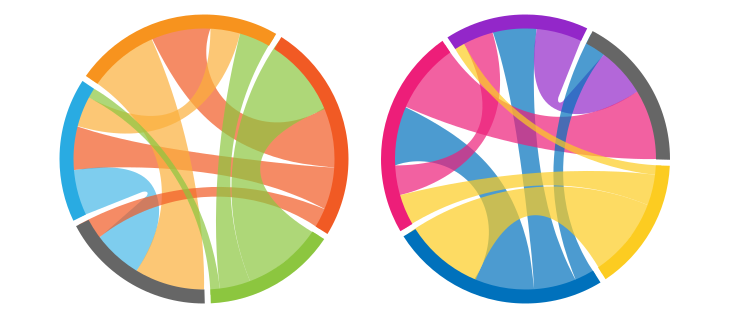
Description
This type of diagram visualises the inter-relationships between entities. The connections between entities are used to display that they share something in common. This makes Chord Diagrams ideal for comparing the similarities within a dataset or between different groups of data.
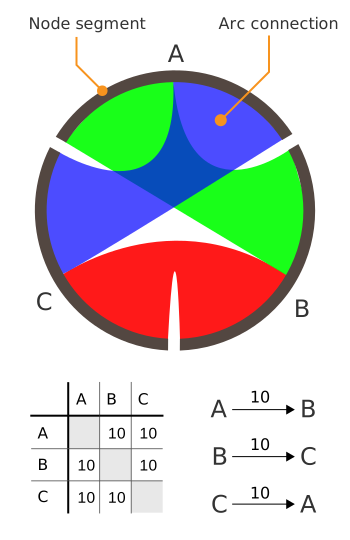
Nodes are arranged along a circle, with the relationships between points connected to each other either through the use of arcs or Bézier curves. Values are assigned to each connection, which is represented proportionally by the size of each arc. Colour can be used to group the data into different categories, which aids in making comparisons and distinguishing groups.
Over-cluttering becomes an issue with Chord Diagrams when there are too many connections displayed.
Anatomy
Thursday, April 30, 2020
Standardised effect size measurements
If you’re in a field that uses Analysis of Variance, you have surely heard that p-values alone don’t indicate the size of an effect. You also need to give some sort of effect size measure.
Why? Because with a big enough sample size, any difference in means, no matter how small, can be statistically significant. P-values are designed to tell you if your result is a fluke, not if it’s big.
Truly the simplest and most straightforward effect size measure is the difference between two means. And you’re probably already reporting that. But the limitation of this measure as an effect size is not inaccuracy. It’s just hard to evaluate.
If you’re familiar with an area of research and the variables used in that area, you should know if a 3-point difference is big or small, although your readers may not. And if you’re evaluating a new type of variable, it can be hard to tell.
Standardized effect sizes are designed for easier evaluation. They remove the units of measurement, so you don’t have to be familiar with the scaling of the variables.
Cohen’s d is a good example of a standardized effect size measurement. It’s equivalent in many ways to a standardized regression coefficient (labeled beta in some software). Both are standardized measures-they divide the size of the effect by the relevant standard deviations. So instead of being in terms of the original units of X and Y, both Cohen’s d and standardized regression coefficients are in terms of standard deviations.
There are some nice properties of standardized effect size measures. The foremost is you can compare them across variables. And in many situations, seeing differences in terms of number of standard deviations is very helpful.
But they’re most useful if you can also recognize their limitations. Unlike correlation coefficients, both Cohen’s d and beta can be greater than one. So while you can compare them to each other, you can’t just look at one and tell right away what is big or small. You’re just looking at the effect of the independent variable in terms of standard deviations.
This is especially important to note for Cohen’s d, because in his original book, he specified certain d values as indicating small, medium, and large effects in behavioral research. While the statistic itself is a good one, you should take these size recommendations with a grain of salt (or maybe a very large bowl of salt). What is a large or small effect is highly dependent on your specific field of study, and even a small effect can be theoretically meaningful.
Another set of effect size measures for categorical independent variables have a more intuitive interpretation, and are easier to evaluate. They include Eta Squared, Partial Eta Squared, and Omega Squared. Like the R Squared statistic, they all have the intuitive interpretation of the proportion of the variance accounted for.
Eta Squared is calculated the same way as R Squared, and has the most equivalent interpretation: out of the total variation in Y, the proportion that can be attributed to a specific X.
Eta Squared, however, is used specifically in ANOVA models. Each categorical effect in the model has its own Eta Squared, so you get a specific, intuitive measure of the effect of that variable.
Eta Squared has two drawbacks, however. One is that as you add more variables to the model, the proportion explained by any one variable will automatically decrease. This makes it hard to compare the effect of a single variable in different studies.
Partial Eta Squared solves this problem, but has a less intuitive interpretation. There, the denominator is not the total variation in Y, but the unexplained variation in Y plus the variation explained just by that X. So any variation explained by other Xs is removed from the denominator. This allows a researcher to compare the effect of the same variable in two different studies, which contain different covariates or other factors.
In a one-way ANOVA, Eta Squared and Partial Eta Squared will be equal, but this isn’t true in models with more than one independent variable.
The drawback for Eta Squared is that it is a biased measure of population variance explained (although it is accurate for the sample). It always overestimates it.
This bias gets very small as sample size increases, but for small samples an unbiased effect size measure is Omega Squared. Omega Squared has the same basic interpretation, but uses unbiased measures of the variance components. Because it is an unbiased estimate of population variances, Omega Squared is always smaller than Eta Squared.
Tuesday, April 21, 2020
Odds Ratio Confidence Interval
Following formula is used to calculate the odds ratio (O.R.) and its confidence interval (C.I.).
OR = a*d / b*c, where:
- a is the number of times both A and B are present,
- b is the number of times A is present, but B is absent,
- c is the number of times A is absent, but B is present, and
- d is the number of times both A and B are negative.
To calculate the confidence interval, we use the log odds ratio, log(OR) = log(a*d/b*c), and calculate its standard error:
se(log(OR)) = √1/a + 1/b + 1/c +1/d
The confidence interval, C.I., is calculated as:
CI = exp(log(OR) ± Zα/2*√1/a + 1/b + 1/c + 1/d),
where Zα/2 is the critical value of the Normal distribution at α/2 (e.g. for a confidence level of 95%, α is 0.05 and the critical value is 1.96).
Note: The logarithms included in the formulae above are natural logarithms, i.e., log base e, sometimes denoted ln().